AI Agent Development for service businesses
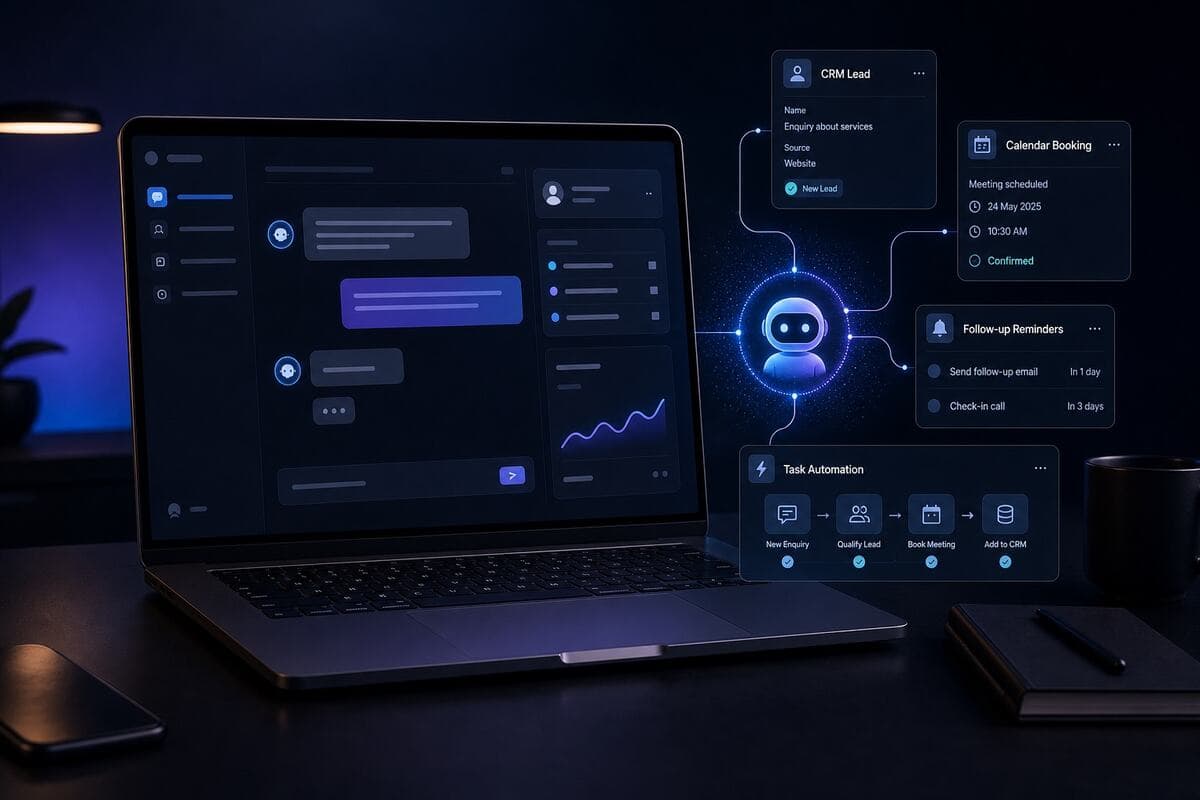
Custom AI agents that take real work off your team: responding to enquiries, qualifying leads, answering questions, booking appointments, and routing tasks to the right person.
What we build
Expected operational impact
Final results depend on workflow volume, team adoption and tool access. The audit validates the business case before build.
The problem this solves
Most service businesses lose enquiries not because they lack the tools to respond, but because the volume of inbound messages — across website chat, email, WhatsApp, phone, and social — exceeds what a human team can manage consistently at speed. AI agents solve this by handling the repeatable, structured parts of those conversations: the first response, the qualification questions, the FAQ answers, the booking confirmation. Your team handles the conversations that actually require human judgement.
How we build it
We start by mapping the conversations your team currently has — identifying which parts are genuinely repetitive and which require human expertise. This tells us exactly what the agent should handle, and where it should hand off. Getting this boundary right is the most important design decision in the build.
The agent is then trained on your specific business: your services, your pricing rules, your FAQs, your tone of voice, and your escalation criteria. We build in hard limits — topics it will not engage with, information it will never provide without human confirmation — and we test against real enquiry scenarios before anything goes live.
After launch, we monitor the first two weeks closely: reviewing conversation logs, identifying edge cases, and refining the agent's responses where needed. Most agents reach production quality within the first month of real usage.
How ai agent development works in a real service business
This service is designed for owner-led and growing teams that need practical systems, not generic automation demos. NexusAI starts with your current enquiry sources, tools, handovers and reporting gaps, then builds the smallest reliable system that can create measurable operational impact.
A typical ai agent development engagement begins by mapping the workflow from the moment a customer, prospect or team member triggers the process. We document the inputs, required decisions, human approval points, data destinations and failure alerts before anything is launched.
The build is then connected to the tools your business already uses where possible — CRM, email, forms, calendars, spreadsheets, WhatsApp, dashboards, Zapier, Make or direct APIs. This reduces change-management risk and makes the system easier for your team to adopt.
Every launch includes test records, edge-case checks, handover notes and a clear owner for monitoring. Sensitive, uncertain or high-value actions are routed to a person instead of being left to automation alone.
Best-fit use cases
AI Agent Development is strongest when the workflow is repeated often, has clear decision rules and currently creates delays, missed leads or manual reporting work.
Risk controls
We define fallback notifications, human handover rules, data handling expectations and escalation routes before launch so the system is maintainable and accountable.
Success measures
Useful metrics often include response time, admin hours saved, lead follow-up rate, CRM completeness, support deflection, booking conversion or reporting turnaround time.
What is ai agent development?
AI Agent Development is a practical business automation service that turns a defined, repeatable process into a tested system with clear inputs, decisions, outputs and human handover points. It is used when a team needs faster response, cleaner records or more reliable follow-up without replacing the judgement of experienced staff.
When should a business use ai agent development?
Use ai agent development when the same task happens repeatedly, the rules are clear enough to document, and delays or missed steps create commercial risk. It is not the right first build for one-off decisions, undocumented processes or work that needs sensitive human judgement at every step.
What does a typical workflow example look like?
A typical workflow starts when a lead, customer or team member submits information through a form, inbox, CRM, booking tool or chat channel. The system checks the data, applies routing rules, updates the right tool, notifies the right person and escalates anything outside scope.
Which related NexusAI services support this?
Questions buyers ask before scoping ai agent development
How do I know whether this is worth automating?
Start with volume, risk and repeatability. If the process happens often, has clear rules and creates missed revenue, delays or admin load, it is a strong candidate for an audit.
What access does NexusAI need?
Most builds need access to the tools involved in the workflow, such as forms, calendars, CRM fields, inbox rules, spreadsheets or automation platforms. Sensitive access can be staged, restricted or reviewed with the business owner before launch.
How is quality checked before launch?
We test sample records, normal paths, exception paths and failure alerts before switching on live automation. The launch plan also defines who monitors the system and how human handover works.
Can the system be changed later?
Yes. NexusAI documents triggers, actions, fields, ownership and escalation rules so the workflow can be adjusted as your business changes.
How this page is sourced and maintained
This service guide is written by NexusAI Solution for buyers evaluating automation options. It avoids invented statistics, case studies, client names or guaranteed outcomes; any external guidance is linked below for verification.
Founder-led automation guidance
This page is maintained by the NexusAI Solution team in Cambridge, UK and reviewed against live service-business workflows, tool capabilities and privacy expectations.
From audit to launch
Questions about AI Agent Development
Can the AI agent replace my team?+
No. We design agents to handle repeatable tasks and escalate anything complex, sensitive or commercially important to a person. The agent handles the routine; your team handles the relationships.
Can it use my own business information?+
Yes. We structure your services, FAQs, pricing rules, policies and process notes so the agent answers from your approved information only — not from the internet or general knowledge.
What channels can the agent operate on?+
Website chat, WhatsApp, email, and any platform with a messaging API. We recommend starting with the channel that has the highest inbound volume for your business.
How long does a build take?+
A focused AI agent with knowledge-base training, one channel integration, and human handover flows typically takes 3–5 weeks from design sign-off to launch.
What if the agent gives a wrong answer?+
We build in guardrails and test against edge cases before launch. Where a question is outside the agent's scope, it is designed to escalate rather than guess. Post-launch monitoring catches and corrects any remaining gaps.
Want this mapped to your business?
Book a free automation audit and we'll identify the best first workflow to automate, the tools required, and the likely build timeline.
Book a free audit